
Low-frequency RFID runs at 125 kHz or 134.2 kHz, using inductive magnetic coupling instead of radio backscatter. It excels at short, deliberate reads (typically 10 to 30 centimeters) in the presence of metal or water, which makes it the default for access control, animal ID, and rugged industrial tracking. Its main tradeoffs are limited range and weak native security compared to HF or UHF systems.
TL;DR:
- Low-frequency RFID's short range and inductive coupling make it ideal for secure access control and animal ID in metal-rich or wet environments.
- Proper resonance tuning, antenna orientation, and avoiding metal interference are critical for achieving reliable read performance in LF RFID systems.
- Security is limited, as legacy LF formats lack cryptography, and anti-collision protocols restrict bulk scanning, influencing system design choices.
- Costs are generally low for tags and affordable but require careful installation and validation to ensure consistent operation across environments.
- Testing tools like AetherKey streamline in-field validation, allowing comprehensive read, clone, and format checks with a single device.
Table of Contents
- What Are the Key Characteristics of Low Frequency RFID?
- How Does Low Frequency RFID Work?
- Where Does LF RFID Outperform HF and UHF?
- How Should Engineers Design and Deploy LF RFID Systems?
- What Are LF RFID's Security and Interoperability Limits?
- How Do You Test and Validate an LF RFID Installation?
- Power Consumption and Battery Life for Active LF Tags
- What Encoding and Modulation Schemes Does LF RFID Use?
- How Do Antenna Designs Affect LF RFID Performance?
- How Is LF RFID Used Across Different Industries?
- What Do LF RFID Components and Systems Cost?
- Publisher Perspective: LF's Role in a Modern Security Toolkit
- Where AetherKey Fits Into LF RFID Fieldwork
- Sources
- FAQ
What Are the Key Characteristics of Low Frequency RFID?
LF RFID's two nominal frequencies serve slightly different markets: 125 kHz dominates access control and asset tags in North America, while 134.2 kHz is the ISO 11784/11785 standard for livestock and companion animal microchips worldwide. Neither is universal by law. Regional regulators set their own power and emissions envelopes, so hardware validated in one market can behave differently elsewhere.
Passive LF tags typically read at 10 to 30 centimeters, and that range depends heavily on antenna size, coil quality (Q factor), and reader transmit power. A tag with a larger coil diameter and higher Q reads farther, but at the cost of a bulkier form factor. That tradeoff shows up constantly in access-control hardware, where card-sized tags trade range for pocketability.
Tag formats split into two broad camps: legacy proximity chips like EM4100 and HID's proprietary formats, and more capable families like T5577 and HITAG that support write access and some configurability. Memory is minimal, usually a few dozen bytes, and none of it was designed with modern cryptography in mind. Passive LF glass transponders used in animal ID can last an animal's lifetime, which is part of why the format persists despite its age.
How Does Low Frequency RFID Work?
LF RFID doesn't broadcast radio waves the way UHF does. It relies on near-field inductive coupling: the reader's coil generates an oscillating magnetic field, and the tag's coil sits inside that field to harvest energy during what's called the charge phase. A passive tag has no battery, so it needs a brief window, often tens of milliseconds, to accumulate enough energy to power its chip and prepare a response.
Once charged, the tag communicates back through load modulation. It doesn't transmit its own signal; instead, it varies the electrical load on its coil, and that variation shows up as a detectable change in the reader's field. This is fundamentally different from the backscatter modulation UHF tags use, and it's why LF systems tolerate detuning environments (metal, liquid) far better than higher-frequency radio-based systems do.
Two timing patterns matter for reader design: half-duplex (HDX) tags charge fully, then transmit after the reader field drops, while full-duplex (FDX) tags transmit while still receiving power. HDX gives longer read range because the tag isn't competing with the reader's own field noise, but it demands the reader firmware manage a charge-then-listen cycle rather than continuous polling. Get this timing budget wrong and reads become inconsistent, especially with tags that have marginal coupling due to poor orientation or distance. Reader firmware built for LF has to account for this asymmetry from the start, not bolt it on later.
Where Does LF RFID Outperform HF and UHF?
Access control is LF's home turf because the short range is a feature, not a limitation. A badge reader that only triggers within a few centimeters avoids the accidental reads and cross-talk problems that plague longer-range HF or UHF systems in crowded doorways.
Animal identification is the other major stronghold, governed by ISO 11784/11785 for the air interface and data structure of implantable transponders. Veterinary and livestock systems worldwide standardized on this decades ago, and switching formats now would mean re-tagging animals across an entire industry.
Industrial tool tracking and asset tagging on metal surfaces is where LF quietly wins over UHF, which degrades badly near metal and liquids. Reach for HF when you need faster data rates or phone compatibility, and UHF when you need to inventory dozens of tags at range. LF is the right call when reliability in a hostile physical environment matters more than speed or volume.
How Should Engineers Design and Deploy LF RFID Systems?
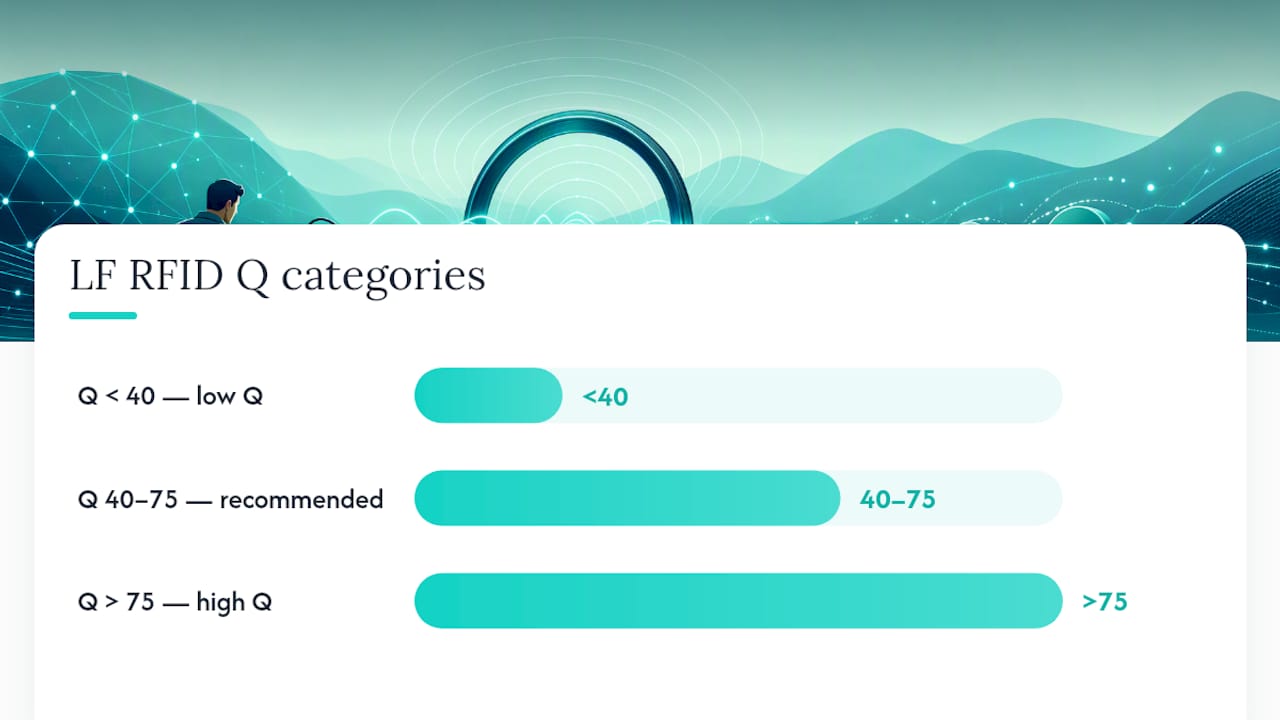
Resonance tuning is where most LF deployments succeed or fail quietly. The tag's resonance frequency depends on its coil inductance and the tuning capacitor, and you need to factor in the chip's own parasitic capacitance when calculating the target. Texas Instruments recommends NPO capacitors and Q factors in the 40 to 75 range for stable read performance on many common LF ICs. Push Q too high and the tag becomes hypersensitive to small detuning shifts from nearby metal or plastic housings; too low and you lose range you can't get back with more transmit power.
Antenna orientation isn't a minor detail. Magnetic coupling peaks when the reader coil and tag coil sit parallel to each other, so a tag presented edge-on to the reader can fail to read even at close range. In tight enclosures, a stick antenna geometry often outperforms a flat loop simply because it's easier to align consistently with handheld tags.
Practical design guidance worth keeping on a checklist:
- Never route ground planes or large metal traces directly under a PCB-mounted LF antenna. Detuning from nearby conductors is the single most common field failure.
- Use ferrite-backed tags for on-metal mounting. The ferrite core redirects the magnetic field around the metal surface, though it adds cost and thickness compared to a standard adhesive tag.
- Test resonance with a spectrum analyzer or network analyzer before finalizing enclosure design, not after tooling is committed.
- Confirm your target market's regulatory envelope. Small frequency and power differences between jurisdictions can affect certification and performance.
Pro Tip: If your read rates drop after switching enclosure suppliers, check the new housing for embedded metal clips or shielding foil before you touch the firmware. A detuned antenna looks exactly like a software bug until you measure it.
What Are LF RFID's Security and Interoperability Limits?
Legacy LF formats like EM4100 carry essentially no cryptography, and cloning a card takes a cheap reader and a few seconds. That's a real constraint for access control, and the practical mitigation is layering: pair the LF credential with a PIN, biometric check, or migrate sensitive doors to encrypted tag families like HITAG Pro where the budget allows.
Anti-collision is another hard limit. LF systems are built around single-tag reads, not bulk inventory. If your application needs to scan a bin of fifty tagged items simultaneously, LF is the wrong band entirely; that's UHF's job.
Interoperability failures are common when readers and tags use different proprietary encodings under the same nominal frequency. Two 125 kHz systems from different vendors aren't guaranteed to talk to each other just because they share a frequency.
How Do You Test and Validate an LF RFID Installation?
Before specifying hardware, run through this order of checks:
- Confirm the read-range specification matches your actual use case, not the vendor's best-case lab number.
- Verify supported tag protocols against what you'll actually deploy, since EM4100 and T5577 aren't interchangeable at the bit level.
- Measure the antenna footprint against your enclosure constraints, factoring in ferrite backing if mounting on metal.
- Check the IP rating against the deployment environment, particularly for outdoor or industrial access points.
- Confirm interface types (Wiegand, RS485, USB) match your existing controller infrastructure.
For field validation, sweep tag orientation across the read zone to map dead spots, run a resonance check with a spectrum analyzer if reads seem inconsistent, and bench-test timing latency between presentation and unlock signal. A properly tuned system should give consistent reads within a tight, repeatable zone. If range varies wildly between two visually identical installs, suspect antenna detuning before you suspect the tags.
Power Consumption and Battery Life for Active LF Tags
Most LF RFID tags are passive, but active LF tags exist for applications needing longer range or onboard sensing, and they change the power equation entirely. Where a passive tag harvests energy only during a brief charge phase, an active tag runs its own transmitter and logic continuously or on a duty cycle, drawing from an onboard battery, typically a coin cell or small lithium pack.
Battery life on active LF tags comes down to duty cycle management. A tag that broadcasts continuously might last months; one that wakes on a motion trigger or a scheduled interval can stretch to several years. Engineers building active LF asset tags generally push as much of the logic into sleep states as possible, waking the transmitter only when a reader is detected nearby or a timer fires.
The tradeoff against passive LF is straightforward: active tags cost more, require battery replacement or disposal planning, and add a maintenance burden that passive tags simply don't have. In exchange, they can support longer range, onboard data logging, or environmental sensing that passive tags can't power. For most access control and animal ID work, passive LF remains the practical choice specifically because there's no battery to replace on a card carried for years or a chip implanted in an animal. Active LF earns its keep mainly in industrial asset tracking, where a tag needs to report periodically over a distance passive coupling can't reach.
What Encoding and Modulation Schemes Does LF RFID Use?
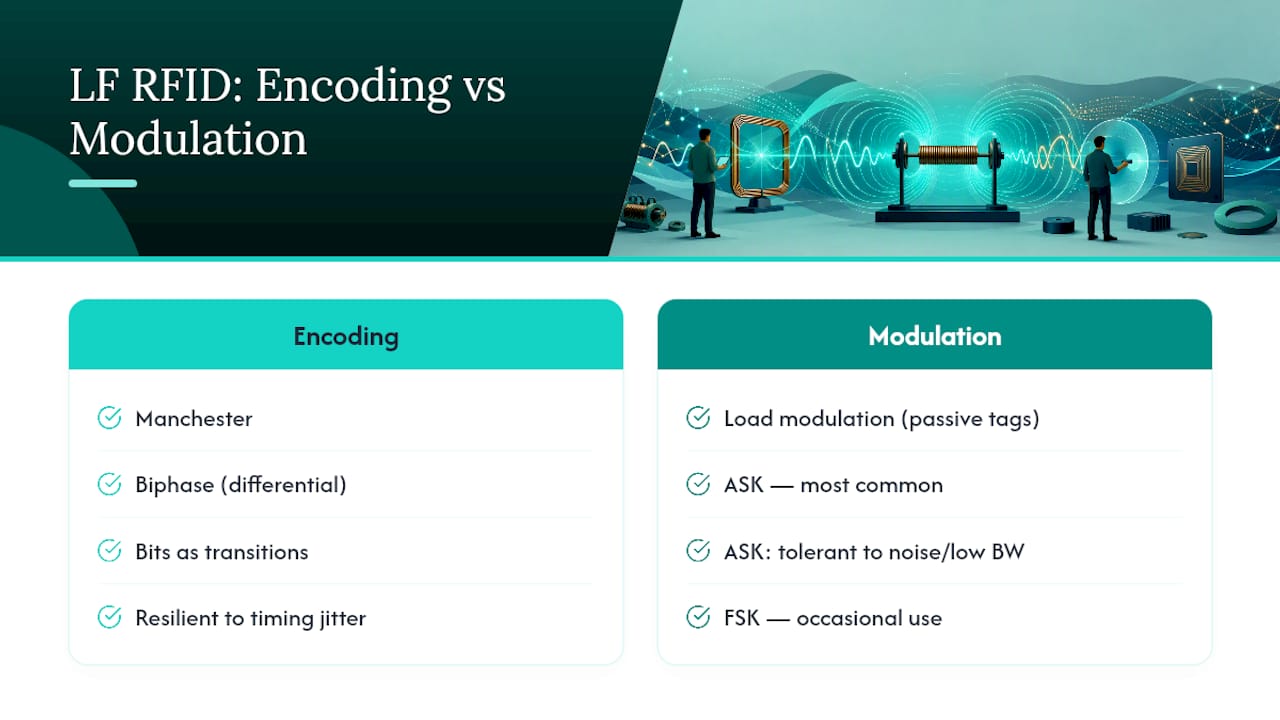
LF RFID's data encoding is deliberately simple, a byproduct of the tight power budget passive tags operate under. Common schemes include Manchester encoding and biphase (differential) encoding, both of which encode bits as transitions rather than absolute voltage levels. That transition-based approach makes the signal more resilient to the timing jitter and weak coupling typical of inductive systems.
On the modulation side, load modulation is the dominant mechanism for passive tags. The tag varies its coil's electrical load in a pattern that corresponds to its data, and the reader detects that variation as amplitude or phase shifts in its own transmitted field. Amplitude Shift Keying (ASK) is the most common implementation, chosen for its tolerance of the noisy, low-bandwidth conditions inductive coupling creates.
Some LF systems use Frequency Shift Keying (FSK) instead, shifting the sub-carrier frequency slightly to represent bits, which can offer better noise immunity in electrically dirty industrial environments at the cost of slightly more complex reader demodulation circuitry.
None of these schemes support high data rates, and that's by design, not a limitation anyone is racing to fix. LF applications don't need to move much data. An access badge or animal microchip typically transmits a fixed identifier, a few dozen bits, not a data stream. The modulation scheme exists to make that tiny payload arrive reliably despite weak coupling, not to maximize throughput.
How Do Antenna Designs Affect LF RFID Performance?
Antenna design determines LF system performance more than almost any other variable, more so than transmit power in most practical installs. Both the reader antenna and the tag antenna are, functionally, tuned coils, and the physics of inductive coupling punishes mismatches between them.
Coil geometry sets the baseline. A larger-diameter coil generally couples better at distance, but larger coils are also more sensitive to nearby conductive materials, which detune the resonance and shrink effective range unpredictably. Reader antenna designers often trade a theoretically larger read zone for the mechanical stability of a smaller, tightly shielded coil that performs consistently near metal doorframes and mounting brackets.
Tag antenna design follows a mirror-image logic. Access cards use flat, wound-wire or printed coils optimized for a specific presentation distance and orientation, while industrial asset tags mounted on metal need ferrite-core backing to route the magnetic field around the conductive surface instead of through it. Skip the ferrite on a metal-mount application and you'll see read range collapse to a fraction of the tag's rated spec, even though the tag itself is functioning correctly.
The practical lesson for system designers: never treat the antenna as a fixed accessory to a chip. It's the actual performance-determining component, and swapping enclosure materials, mounting surfaces, or even paint can shift resonance enough to matter.
How Is LF RFID Used Across Different Industries?
Access control remains LF's largest deployment base by sheer installed volume. Office buildings, parking garages, and hotel systems worldwide still run on 125 kHz proximity cards, largely because the infrastructure is cheap, well understood, and doesn't require replacing wiring that's been in the wall for two decades.
Animal identification runs on a genuinely global standard. Veterinary clinics, shelters, and livestock operations rely on ISO 11784/11785-compliant implantable transponders that a scanner can read regardless of manufacturer, a rare example of true cross-vendor interoperability in the LF space.
Industrial tool and equipment tracking leans on LF specifically because factory floors are full of the metal that ruins UHF performance. A tagged wrench or fixture sitting on a steel cart still reads reliably at LF frequencies where a UHF tag in the same position might not read at all.
Field-deployable multi-protocol tools illustrate how practical LF tooling has become outside dedicated industrial readers. Devices like Flipper Zero's 125 kHz module demonstrate that reading, emulating, and writing common LF card formats no longer requires specialized lab equipment, a shift that matters for engineers running quick on-site format checks.
What Do LF RFID Components and Systems Cost?
LF hardware sits at the affordable end of the RFID spectrum, which is a big part of why it has survived so many decades of newer alternatives. Passive tags, whether access cards, key fobs, or glass animal transponders, are inexpensive to manufacture at volume, and their long service life further lowers the total cost of ownership since replacement cycles are rare.
Reader hardware costs vary more, driven mainly by antenna size, IP rating, and interface complexity. A basic Wiegand-output proximity reader for an office door sits at the low end of the market. Ruggedized industrial readers built for outdoor mounting or metal-heavy environments cost more, largely because of the enclosure engineering and antenna shielding needed to hold resonance in harsh conditions.
The bigger cost driver in most deployments isn't the tag or reader hardware at all. It's system integration: wiring, controller infrastructure, and the labor of tuning antenna placement during installation. Engineers who skip field validation to save time often pay for it later in service calls when read reliability turns out to be inconsistent across doors that looked identical on paper. Budgeting time for the resonance and orientation checks described earlier isn't optional overhead. It's the line item that determines whether the cheap hardware actually performs as specified once it's mounted.
Publisher Perspective: LF's Role in a Modern Security Toolkit
LF isn't legacy clutter. It's a specialized tool that still beats HF and UHF for short, deliberate reads near metal, which is exactly why our field validation work keeps LF alongside NFC and UHF rather than retiring it.
— Prada
Where AetherKey Fits Into LF RFID Fieldwork
Testing an LF installation properly means checking tag formats, cloning risk, and read consistency on-site, not just in a lab. AetherKey handles that without forcing you to carry a separate 125 kHz reader, a laptop, and a second device for sub-GHz checks.
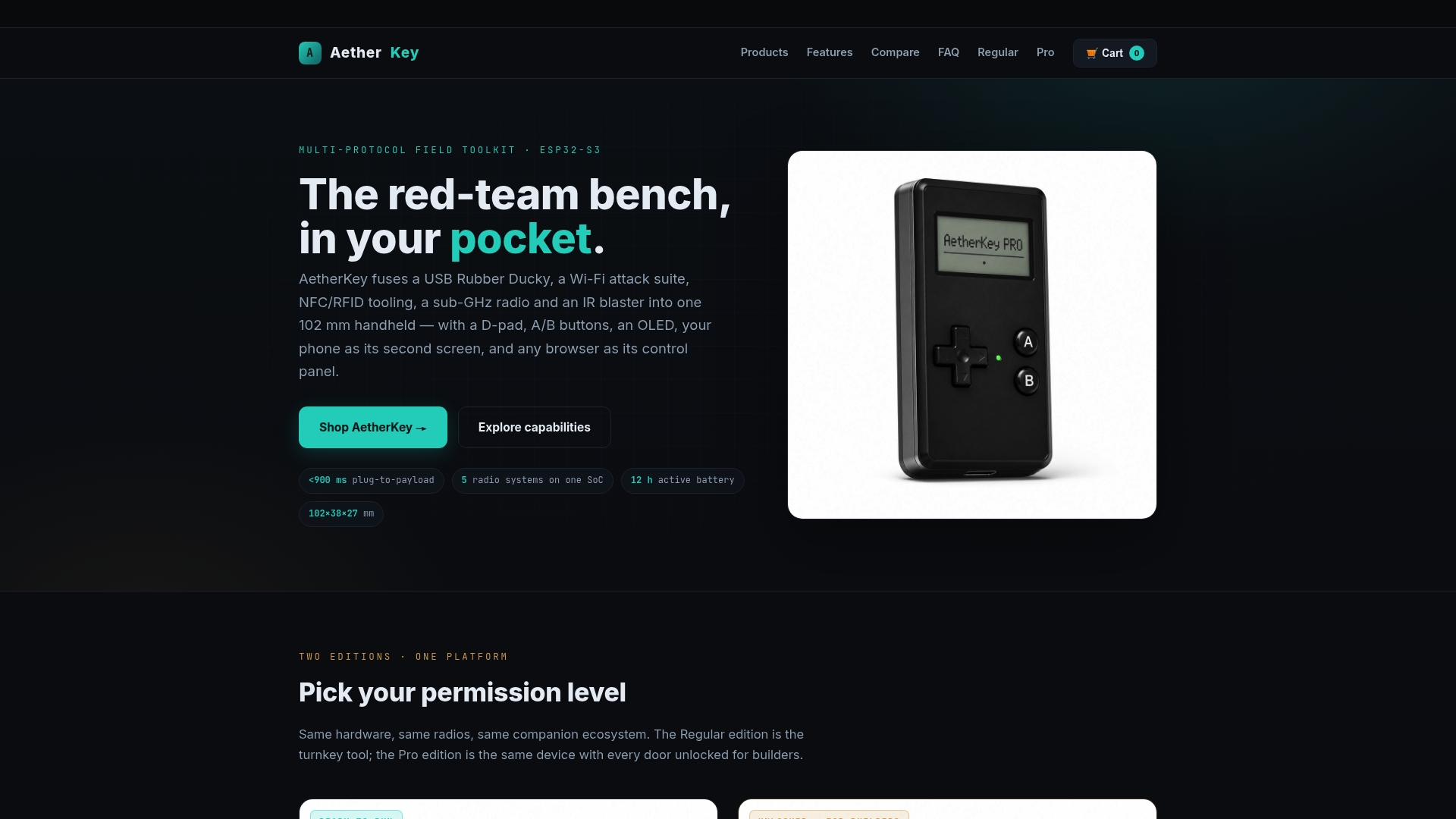
Its NFC/RFID read-write-emulation module lets you pull a badge's data, test whether it clones easily, and verify format compatibility against a reader in the field, the same kind of quick diagnostic useful for catching interoperability mismatches before a client's install day. Pair that with the sub-GHz capture capability and you can validate an access-control site's full attack surface, LF credentials included, from one compact device instead of a bag of single-purpose tools. Engineers who spec or audit LF systems for a living get more out of one toolkit that covers the read/write/emulation workflow than out of juggling vendor-specific hardware for every protocol. Check the full specs and ordering details to see which edition fits your fieldwork.
Sources
- Low-Frequency RF Communication (TI application report)
- LF, HF, UHF—How to Select the Ideal RFID Frequency Range for Your Application - Pepperl+Fuchs (2023)
- What is the difference between low, high and ultra-high frequencies? - GS1 Support
- Low Frequency RFID Reader Guide | 125kHz LF RFID Technology & Applications - CPCON
- 125 kHz RFID - Flipper Zero Documentation
FAQ
Can an iPhone read 13.56 MHz RFID?
Yes, but only HF tags. iPhones support NFC, which operates at high frequency, not in the 125 kHz or 134.2 kHz bands LF RFID uses, so no iPhone can read a standard LF proximity card or animal transponder.
What Are the Key Differences Between High and Low Frequency RFID?
LF operates at 125/134.2 kHz with short range (10 to 30 centimeters) and strong resilience near metal and water, while HF runs at high frequency with faster data rates, phone compatibility, and moderate range. LF trades speed and smartphone support for reliability in harsh physical environments.
What Is 125 kHz RFID Used For?
125 kHz RFID powers most building access control systems, employee badges, key fobs, and many industrial asset tags mounted on metal. It's also common in vehicle immobilizer keys and some livestock tracking setups outside the ISO 134.2 kHz standard.
What Are the Downsides of RFID Technology at Low Frequency?
Legacy LF formats carry minimal cryptography, making cloning straightforward with basic equipment, and the format supports only single-tag reads, not bulk inventory. Range is also limited to centimeters, and it lacks the smartphone compatibility HF offers through NFC.
Is LF RFID Still Relevant Compared to HF or UHF?
Yes, for specific jobs. LF remains the more reliable choice for short-range access control, animal identification, and asset tracking on metal or near liquids, exactly the conditions where UHF performance degrades most.